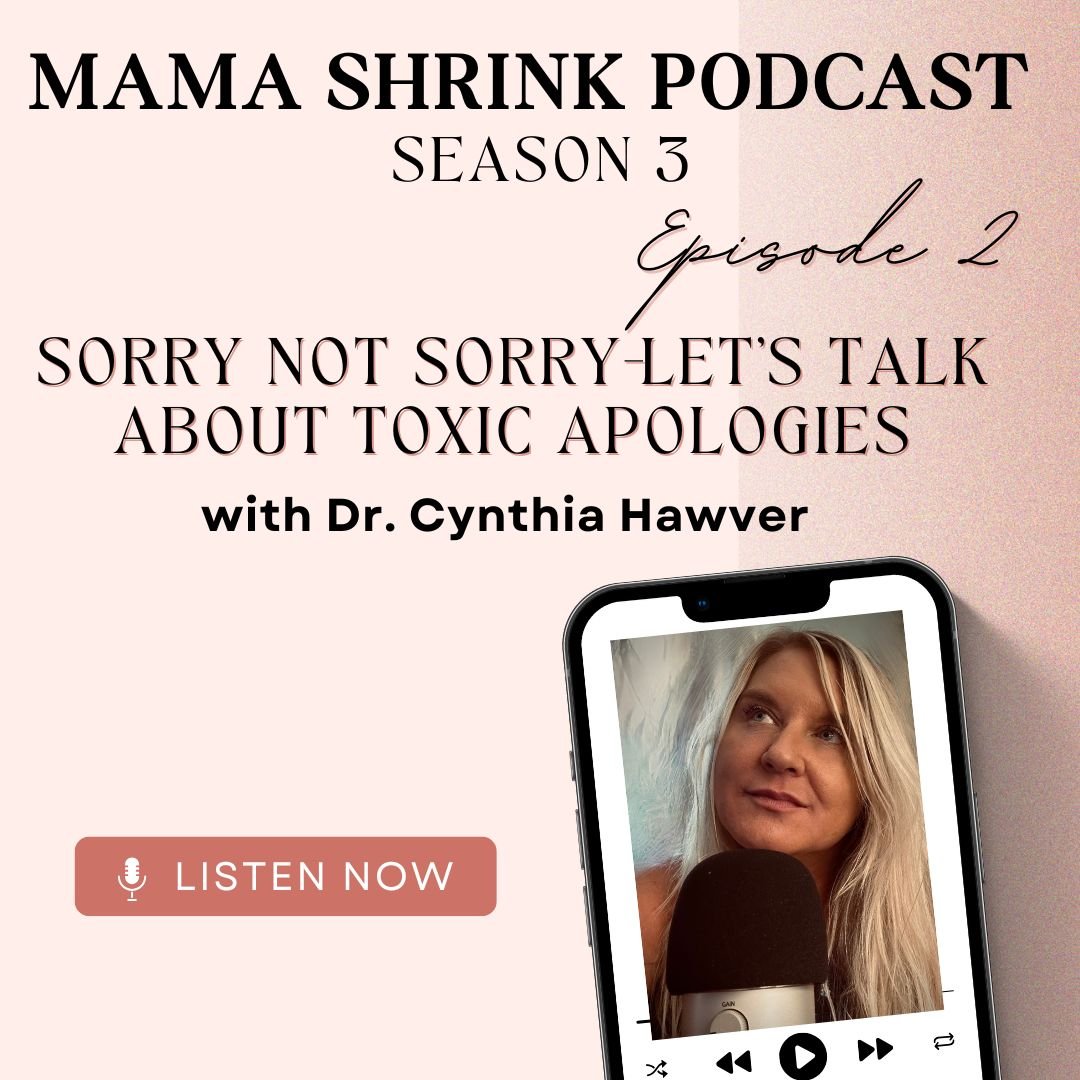
Episode Two: Sorry Not Sorry: Let’s Talk About Toxic Apologies
Have you ever received an apology that left you feeling worse?
In this powerful episode of The Mama Shrink Podcast, Dr. Cynthia Hawver breaks down the subtle art of the toxic apology. If you’ve ever felt confused, blamed, or dismissed after someone said “sorry,” this one’s for you.
You know the feeling. The argument ends. He says sorry. And somehow you walk away feeling worse than before.
More confused. More depleted. More like maybe it actually was your fault.
That is not an apology. That is a weapon dressed up as one.
In this episode of The Mama Shrink Podcast, Dr. Cynthia gets honest about toxic apologies — what they are, why they work, and why you keep falling for them even when part of you knows something is deeply wrong. Not because you're weak. Not because you're naive. But because you grew up in a world that didn't always show you what healthy love actually looks like — and because "a little better" can feel like enough when you're exhausted and scared and trying to hold everything together.
She talks about the feelings you might not be letting yourself fully name yet. The anxiety that doesn't go away. The depression you keep pushing through. The panic attacks that seem to come out of nowhere. The way your health is suffering and you keep telling yourself you'll deal with it later. The same fight, with the same excuses, following the same pattern — over and over — while you keep hoping this time will be different.
And the terror. The real, physical terror of admitting the truth — about the relationship, about what staying is costing you, about what you're afraid will happen if you actually say it out loud.
This episode is permission to honor all of it.
You don't need a diagnosis. You don't need a label. You don't need to prove it was bad enough. If you leave every interaction feeling confused, manipulated, unheard, or like your truth simply doesn't matter — that is information. Healthy love does not make you feel crazy. Healthy love does not leave you questioning your own reality. Healthy love does not send you away from an apology feeling worse than before it happened.
In this episode:
What a toxic apology actually sounds like — and why "I'm sorry you feel that way" is not an apology
The 3 elements of a real, healing apology and why they matter
Why you keep leaving interactions feeling confused, depleted, and like somehow it's your fault
How toxic apologies fuel trauma bonding, codependency, and anxious attachment
The role your childhood played in making this pattern feel familiar — even normal
Why "a little better" keeps you stuck in a cycle that never actually changes
What happens to your body and your mental health when your reality is consistently not honored
The fear of sharing your kids, the family court system, and why you stay even when you know
Why you don't need a label to know that what you're living isn't okay
How to start trusting yourself again when your reality has been questioned for so long
How your body reacts around your partner — and why that reaction is data
Why children living in constant tension may be harmed by staying — not just by leaving
Why you don't need to wait for absolute certainty to trust what you already know
Radical acceptance of the truth — and the grief that comes with finally letting it be real
You deserve to feel validated, even before you have all the answers
She also talks about something that doesn't get said enough: that sometimes the most protective thing you can do for your children is leave.
Not because divorce is easy. Not because it doesn't cost everyone something. But because children who grow up inside constant tension — watching their mother completely depleted, burned out, and disappearing into herself — are being harmed by that too. The question was never only "will divorce hurt my kids." The question is what staying is already costing them.
And you don't need to wait for absolute certainty before you trust what you already know. You don't need a perfect plan. You don't need a label or a diagnosis or a court order to validate what your body has been telling you for years.
Speaking of your body — how does it feel around your partner? Does it brace? Does it hold its breath? Does it relax or does it stay on guard even in the quiet moments? Your nervous system has been keeping score even when your mind was busy making excuses. That is information worth listening to.
This episode also walks through the grief that comes with radical acceptance — the moment you stop arguing with the truth of your situation and finally let yourself feel the weight of what is real. That grief is not a sign you are making the wrong decision. It is a sign that what you're losing actually mattered. And it is the beginning of something that can finally be built on solid ground.
You are allowed to grieve and still know it's right.
If you are a woman who is anxious, depleted, depressed, and not even sure why — this episode is your starting point.
Your feelings are not too much. Your truth is not up for debate. And the confusion you feel is not a character flaw. It is what happens when someone keeps moving the goalposts and calling it love.
You deserve so much better than sorry not sorry.